Opera Experience
Opera is the art that more than any other involves so many dimensions of expression: from singing to speaking, from theatrical gesture to sharing the musical narrative. With Opera experience, the Piccolo Opera Festival opens up further avenues to an already rich genre and brings opera (and generally vocal music) out of halls, theaters and sacred places so that art can become a well-rounded experience, immersed in the landscape, in the territory, among the community.
Places

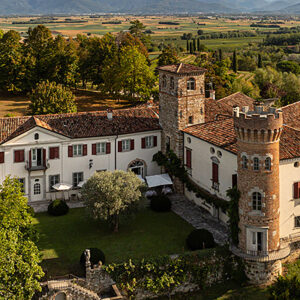
Azienda Agricola Specogna
It was 1963 when Leonardo Specogna, after spending several years as an emigrant in Switzerland (a typical fate for people from Friuli at the time), returned to Friuli Venezia Giulia and passed through the hills of Rocca Bernarda in Corno di Rosazzo for the first time. He fell in love with their beauty and the history that set them apart, and so decided to invest his savings in purchasing a small plot of land in this area at the heart of the Friuli wine region. Land with a strong winemaking tradition, where the vine thrives thanks to unique and exceptional climatic and geological conditions ideal for viticulture.
Year after year, thanks to Graziano Specogna’s dedication, vineyard management and winemaking techniques began to improve, with the estate specialising primarily in wine production. Today, the work is carried on by the third generation of Specogna winemakers, Cristian and Michele, who have been at the helm of the business for some time now. It is they who, with great passion, are focusing on the constant improvement of work in the vineyard and in the cellar, driven by the desire to make the world increasingly and ever more fully aware of the potential of the Friuli Venezia Giulia region. Today, the estate covers an area of approximately 30 hectares, of which around 25 are vineyards managed according to the principles of organic farming.

Cathedral of Gorizia
The Cathedral of Gorizia (Cathedral of St. Hilary and Tatian) is dedicated to the city’s patron saints, St. Hilary, bishop of Gorizia, and St. Tatian, martyr. The cathedral is located in the historic center of Gorizia and is an important religious and cultural landmark for the city. With its imposing facade and an interior rich in works of art, it is an important testimony to the city’s religious and cultural history. Built in the 13th century, the cathedral has undergone several renovations over the centuries, but has kept its solemn beauty intact. Inside you can admire frescoes, altars and sculptures that tell the story of local faith and tradition. Today the Cathedral of Gorizia is a place of prayer and meeting for the community, but also an important tourist destination, attracting visitors for its architecture and for the quiet it offers in the heart of the city.
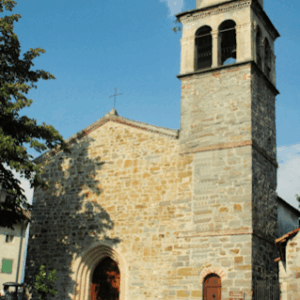
Chiesa di Santo Stefano Protomartire – Giassico
The little church, dating back to the 15th century, is situated in the centre of the village of Giassico, first recorded in 1329 as Yasicho. It has a history stretching back several centuries, inextricably linked to Brazzano, of which it was a hamlet until 1925, when it lost its municipal autonomy and was incorporated into the municipality of Cormons.
The church, dedicated to Saint Stephen the Protomartyr, is a little gem nestled in a corner of the village that still retains the simple beauty of Friulian rural architecture, which has remained unspoilt over the centuries. The church has undergone various renovations and extensions. In 1802, the apse was rebuilt and raised to its current height. Previously, the apse probably resembled the one we can see in the church of Sant’Apollonia in Cormons. The bell tower was built in 1885 and resembles, albeit on a smaller scale, that of the parish church of San Lorenzo in Brazzano. The bell tower replaced the two-bell bell gable.

Church of St. Anthony in Medea
The Church of St. Anthony in Medea is a charming place of worship in the heart of the town of Medea, in the province of Gorizia. Built in the 17th century and renovated over time, the church has a sober Baroque facade and a simple but richly beautiful interior with frescoes decorating the walls and ceiling. The high altar, depicting St. Anthony of Padua, the church’s patron saint, is one of the most striking features. Every year, numerous faithful gather there to celebrate the feast of the saint. Immersed in greenery and surrounded by an enchanting hilly landscape, the church offers a panoramic view of the surrounding rolling hills, vineyards and fields that characterize Collio. The tranquility of the place and the natural setting make this shrine a spiritual and cultural landmark, ideal for those seeking a place of peace, reflection and beauty.

Church of the Blessed Virgin of Relief – Cormons (GO)
The Church of the Blessed Virgin of Relief, known as the Church of St. Anne, was built in 1636 by Baron Luca Del Mestri to replace the Church of St. Peter, demolished in 1525. The façade, in late Renaissance style, has undergone changes over the centuries, including the demolition of a portico in 1889. The interior preserves a 17th-century Baroque wooden high altar and statues of St. Peter and St. Anne.
This evocative place, nestled in the quiet of Mount Quarin, offers a breathtaking view that sweeps from the city of Cormòns to the plains and lagoon of Grado, providing an unparalleled experience of tranquility and beauty.
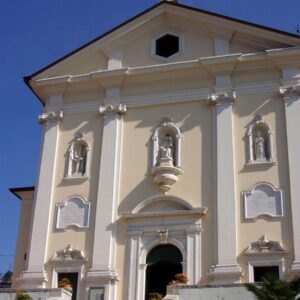
Duomo di Sant’Adalberto – Cormons
The Cathedral, dedicated to Saint Adalbert, is the main church in Cormòns, impressive for its grandeur, its location and its bell tower, which is second in height only to that of Aquileia in the entire Diocese of Gorizia.
The first mention of a church dedicated to Saint Adalbert dates back to 1289, in a contract drawn up in the ‘villa of Cormons in front of the church of Saint Adalbert’; in 1365, meanwhile, there is a reference to a ‘site located in the centre of Saint Adalbert’
Construction of the present building began in 1756, with the partial demolition of the old church and the incorporation of the old church into the new structure; the old church remained intact during this time to ensure the continuity of religious services. The works were completed in 1762, but the construction took several more years and was finally concluded in 1822 with the consecration by Archbishop Giuseppe Walland.
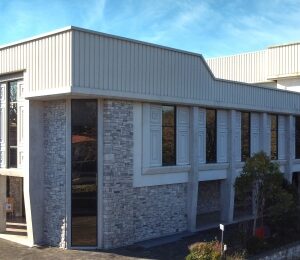
Kulturni Center Lojze Bratuž – Gorizia
The Kulturni center Lojze Bratuž has been an important cultural landmark in Gorica for more than 60 years. Founded in 1952 with the aim of providing the Slovenian community with a community center, it was officially opened on February 25, 1962 as a theater hall and cultural center. Over the years it has hosted numerous organizations and activities, including choirs, theater groups, and sports associations.
In 1996, the center was completely renovated to the design of Gorizia architect David Faganel, reopening with a modern and elegant structure. Today it houses a theater hall, an art gallery, a convention hall and various spaces dedicated to culture and conviviality.
The Kulturni center Lojze Bratuž continues in its role as a cultural, educational and recreational center of local, national and international significance, cooperating with numerous Italian and European organizations.

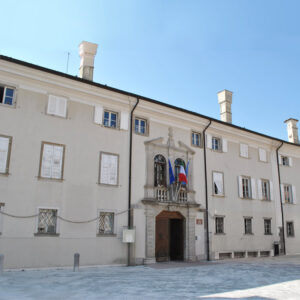
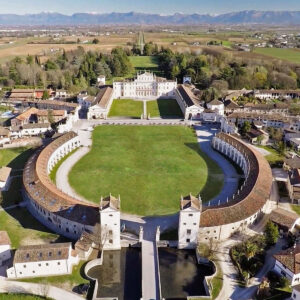
Locatelli Palace
Palazzo Locatelli, an elegant 18th-century Palladian-style residence, is home to the Municipality of Cormons, the town’s Enoteca and the Civic Museum of the Territory.
The building’s name derives from the Locatelli family of Bergamo, who built it and lived in it from the mid-18th century. The facade, decorated with the family coat of arms, highlights the historical importance of the building.
Beyond the entrance, which leads to the Italian garden, is the Museo Civico, with works by Alfonso Canciani. On the main floor are frescoes from the second half of the 19th century by the artist Antonio Picco.
Architect Podrecca’s intervention in the 1980s further enhanced the palace.

Shrine of St. Mary Queen of the Peoples in Preval – Mossa (GO)
Preval is a corner of outstanding natural beauty, nestled among the rolling hills that separate the Soča River from its right tributary, the Judrio River. This area, located between Italy and Slovenia, straddles the border, offering a natural spectacle that ranges from the vineyards and forests of the surrounding hills to the majestic peaks of the Julian Alps, which dominate the horizon. The Sanctuary of Santa Maria del Preval, dating back to the 13th century and evidenced by both archaeological remains and archival documents from the 1300s, is a place of deep spirituality. The atmosphere that envelops this shrine is made even more evocative by the silence of the surrounding nature, creating a perfect balance between sacredness and scenic beauty. The sanctuary itself is a haven of peace, with its sober and harmonious architecture that fits perfectly into the mountainous setting, offering visitors a unique experience where history and nature come together in a timeless embrace.

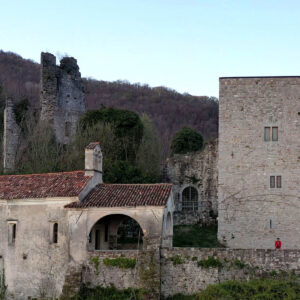
Spessa Castle
Spessa Castle, located in the heart of the Gorizia Collio, is surrounded by the greenery of its centuries-old park and golf course. Its origins date back to the 13th century, with traces of Roman settlements. For centuries, it was home to noble families from Friuli, including the Dorimbergo, Rassauer and Della Torre Valsassina families, who owned it for more than 300 years.
In 1773, Giacomo Casanova visited the castle, praising the local wines in his Memoirs. Today, in the medieval cellars beneath the castle, red wines are aged in barriques and are connected to a World War II military bunker. Nineteenth-century renovations, designed by architect Ruggero Berlam, gave the structure a neo-Gothic feel.

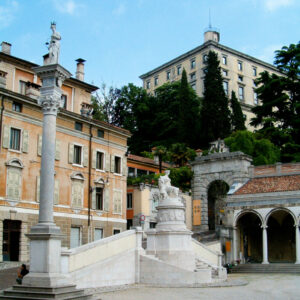
Strassoldo Palace
In the 16th-century Strassoldo Palace, named after one of Gorizia’s oldest patrician families, the Court of the French Royalty, who had come to Gorizia, then considered the “Austrian Nice,” settled in 1830. After the King’s death, the Duke of Angoulême Louis Anthony Count of Marnes accepted the royal title and the Palace became the meeting place for numerous French guests.
The building underwent renovations during the 17th century, and in the last quarter of the 18th century it was expanded to its present size; it has a remarkable 18th-century facade.
The interior spaces were modified as follows: a well, still well preserved, remains visible in the center of the courtyard; the main elevation is regulated by a small central attic with three windows; the family coat of arms is set on the tympanum; and the main floor was accessed via the sixteenth-century four-flight, square staircase located on the left side of the hallway.
Today, the building that overlooks St. Anthony Square is home to the Entourage Hotel and the operational headquarters of Go! Borderless Opera Lab .

Tenuta Della Casa
At Tenuta Della Casa, every vine, every stone, and every glass of wine carries the memory of deep time. From the ancient seabeds that formed Ponca to the quiet resilience of fungus-resistant vines, our story is part of something far greater — a slow, steady evolution shaped by geology, culture, and care. Rooted in Collio yet open to the world, we cultivate not just sustainable wines, but a living connection between past and future, tradition and innovation, people and place.

Villanova Estate
Tenuta Villanova in Farra d’Isonzo is an enchanting farm nestled in the heart of Collio, where tradition, nature and passion for wine meet in perfect harmony. Surrounded by vineyards hugging the hillsides, the estate offers breathtaking scenery, a corner of paradise that provides moments of peace, beauty and, above all, an encounter with the true spirit of Collio. Founded in 1499, Tenuta Villanova is the oldest winery in Friuli Venezia Giulia, with a tradition intertwined with the land. For centuries, the estate has carried a vocation for quality that has been passed down through generations. The estate’s architectural complex testifies to the deep connection with the land. The vineyards enjoy an ideal microclimate that, together with the particular “ponca” of the soil, gives the wines a unique freshness and aromatic richness, typical of Collio DOC wines.